October 11, 2025
From Lab to Clothing: Powering the Future with Solar Textiles

In 2010, China faced a devastating air pollution crisis that claimed 1.2 million premature deaths, a stark reminder of the deadly toll environmental degradation can exact on human life. Fast-forward to today, and China’s transformation offers one of the most remarkable environmental success stories of the 21st century. But can Vietnam learn from China’s playbook to tackle its own growing air quality challenges?
Professor Jintao Xu from Peking University, a leading environmental economics expert, recently highlighted China’s extraordinary achievement at the AIRPACT Vietnam 2025 conference. “Between 2013 and 2021, China slashed average PM2.5 concentrations from approximately 72 μg/m³ to just 30 μg/m³ – a stunning 62% reduction across major cities including Beijing, Shanghai, and Guangzhou.”
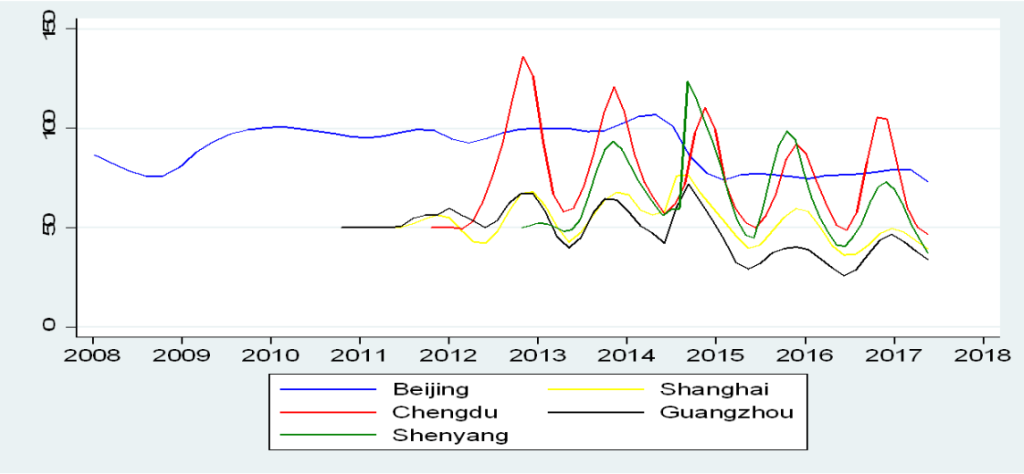
Air Quality in 05 Cities: 2008 – 2017
Daily Average PM2.5 (Source: US Embassy)
China’s success didn’t happen overnight. It was the result of a carefully orchestrated three-phase approach.
Phase 1 (2013-2017): The Foundation
The Air Pollution Prevention and Control Action Plan targeted key regions including the Beijing-Tianjin-Hebei area, Yangtze River Delta, and Pearl River Delta. The strategy focused on establishing regional joint prevention mechanisms and shutting down small, heavily polluting factories
Phase 2 (2018-2020): The War Declaration
The Three Year Action Plan for Winning the War to Protect Blue Skies expanded coverage and intensified efforts through comprehensive structural adjustments in industry, energy, and transportation and strengthened regional coordination mechanisms
Phase 3 (2021-2025): The Integration
Current efforts now synergize air pollution control with carbon neutrality goals, demonstrating China’s commitment to long-term environmental sustainability.
Research by Professors Xu Liu and Jintao Xu revealed that China’s “fee-to-tax” environmental reform led to significant SO2 emission reductions, particularly in heavily polluting sectors. The study found that emissions decreased primarily through enhanced pollution control measures, followed by reduced industrial output, proving that economic instruments can drive meaningful environmental change.
Industrial Transformation:
Regulatory Innovation:
Technological Integration:
Beijing’s targeted approach offers a blueprint for urban air quality management. The city focused on what mattered most to residents – their health – by prioritizing PM2.5 control based on actual community health data rather than chasing abstract pollution numbers.
The breakthrough came through dense sensor networks that created a real-time map of air quality across the city. AI systems then turned this data into predictions, forecasting pollution episodes before they happened and identifying the best intervention points. Beijing also connected previously isolated information streams: traffic cameras, industrial monitors, weather stations, and social media posts; creating a comprehensive picture that enabled precise responses rather than disruptive citywide shutdowns.
These government initiatives achieved remarkable effectiveness in improving urban air quality, with improvements visible to the naked eye. The data tells an equally compelling story: a 62% reduction in PM2.5 concentrations across major cities including Beijing, Shanghai, and Guangzhou, according to Professor Xu.
However, Professor Xu points out that the threat remains in the rising O3 levels, which increased and offset health benefits by 38.6%. Scientists have proven there’s a complex relationship between PM2.5 and O3 that makes this challenge even more intricate. Li K. et al. (2019) and Li K. et al. (2019) found that PM2.5 can inhibit the generation of O3 by absorbing hydrogen peroxide (HO2) and nitrogen oxide (NOx) radicals. Conversely, Lin et al. (2023) found that PM2.5 could promote O3 formation by scattering light in the Pearl River Delta region.
The health implications are significant: short-term co-exposure to both PM2.5 and O3 pollution significantly increases mortality. During 2013 to 2018, reduced PM2.5 pollution decreased daily deaths by 5.95%, while rising O3 pollution increased daily deaths by 2.30%. This complex relationship makes co-control of PM2.5 and O3 challenging, highlighting that air quality management requires continuous adaptation and multi-pollutant approaches.
As Vietnam continues its rapid urbanization and industrialization, the lessons from China’s experience become increasingly relevant. Vietnamese cities face similar challenges: industrial emissions, vehicle pollution, construction dust, and coal dependence.
The question isn’t whether Vietnam can replicate China’s success, it’s how quickly Vietnamese policymakers can adapt these proven strategies to local conditions. With growing environmental awareness among Vietnamese citizens and increasing economic resources, the foundation exists for transformative change.
China’s “Blue Sky” victory proves that even the most polluted environments can be cleaned up with sustained effort and smart policies. For Vietnam, the roadmap exists, the challenge now is implementation.
The stakes couldn’t be higher. As Professor Xu’s data shows, the difference between action and inaction isn’t just measured in air quality indices – it’s measured in human lives saved and futures secured for generations to come.
Vietnam stands at a crossroads. Will it follow China’s lead toward cleaner skies, or will it repeat the environmental mistakes that once plagued its northern neighbor? The choice and the opportunity remains in Vietnamese hands.
Li, K., Jacob, D. J., Liao, H., Shen, L., Zhang, Q., & Bates, K. H. (2019). A two-pollutant strategy for improving ozone and particulate air quality in China. Nature Geoscience, 12(11), 906–910. https://doi.org/10.1038/s41561-019-0464-x
Lin, J., Xue, T., Li, T., Zhao, Y., Wang, Y., & Huang, X. (2023). Enhancement of ozone formation due to PM₂.₅-induced light scattering in the Pearl River Delta, China. Atmospheric Environment, 298, 119675. https://doi.org/10.1016/j.atmosenv.2023.119675
The People’s Government of Beijing Municipality. (2020, July 30). Three-year action plan for protecting Beijing’s blue skies. https://wb.beijing.gov.cn/en/policy_release/others_1/202007/t20200730_1966373.html
Huang, H., Xia, F., & Xu, J. (2022). Health effects of air pollution involving multiple pollutants: The impact of co-exposure to PM₂.₅ and O₃ on mortality in China (EfD Discussion Paper Series No. 22-04). Environment for Development. https://www.efdinitiative.org/sites/default/files/2022-10/Fan%20Xia%204E.pdf

